
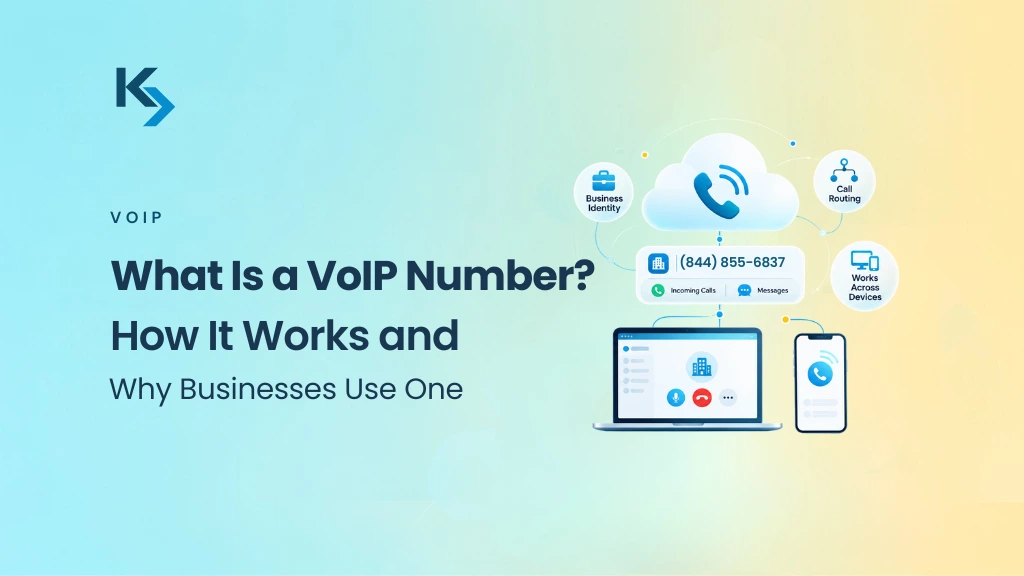
A VoIP number is a phone number that makes and receives calls over the internet instead of a traditional phone line. Unlike a landline tied to one location or device, a VoIP number is assigned to a user or account, so the same business number can ring on a desk phone, a laptop, or a mobile app anywhere with an internet connection.
If your team takes calls in the office one day and from home the next, the phone number is the piece that has to keep up. A VoIP number is what makes that possible. It gives a business one number that travels with the person instead of staying wired to a desk. This guide explains what a VoIP number is, how it works, the types available, how it compares to a landline and a mobile number, and what to check before you get one.
What Is a VoIP Number?
VoIP stands for Voice over Internet Protocol, so a VoIP number is a phone number that routes calls over the internet. It is sometimes called a virtual phone number or an internet phone number. To anyone calling you, it looks and dials like any other number. The difference sits in the background: instead of a fixed copper line running to one address, the number is tied to your account and delivered over your internet connection.
That single change is what lets one business number ring in several places at once. A call can reach a desk phone, a softphone app on a laptop, and a mobile device at the same time, so whoever is free can answer. For a small team, that means fewer missed calls without anyone carrying a second phone.
How Does a VoIP Number Work?
When someone calls your VoIP number, your voice is captured and converted into digital data. That data is split into small packets, sent across the internet, and reassembled into clear audio on the other end. The whole exchange happens in milliseconds, so the call sounds like any other.
Two protocols do the work behind the scenes. SIP (Session Initiation Protocol) sets up and ends the call. RTP (Real-time Transport Protocol) carries the audio once the call connects. Because the number lives in your provider’s cloud rather than on a physical line, you can use it from a desk phone or a cloud based softphone(K7 One) on a laptop or phone. Call quality depends on your internet connection, so a stable network with enough bandwidth is the one real requirement, which is why the connection behind the phones matters as much as the phones themselves.
VoIP Number vs Landline vs Mobile
All three let you make and take calls, but they behave differently in ways that matter for a business.
| Factor | VoIP Number | Landline | Mobile |
|---|---|---|---|
| Location | Works anywhere with internet | Fixed to one address | Portable on cellular |
| Devices | Desk phone, laptop, tablet, app | One wired phone | One handset |
| Cost | Predictable per user plan | Per line plus long distance | Carrier voice and data plan |
| Features | Routing, voicemail to email, SMS | Basic calling | Calling, texting, apps |
| Scaling | Add numbers in minutes | New line and wiring | New line per device |
A landline is dependable but tied to a place. A mobile number is portable but personal, and it does not give you shared lines, routing, or call records across a team. A VoIP number combines the reach of mobile with the control of a business system.
Types of VoIP Numbers for Business
You can choose the type of VoIP number that fits how you want customers to reach you.
- Local numbers carry a specific area code, which helps you show a presence in a market and lifts answer rates because people recognize the code. You can hold a local number for a city without an office there.
- Toll free numbers (800, 888, and similar) let customers call at no cost to them, which suits national sales and support lines.
- Vanity numbers spell a word or phrase, such as 1 800 FLOWERS, and work as a memorable branding asset.
Beyond these, businesses use direct inward dialing (DID) numbers to route callers straight to a person or department, international numbers to appear local in another country, and ported numbers to bring an existing number over without losing it. Most teams mix a few types on one platform and manage them through a single cloud based softphone system.
Fixed vs Non Fixed VoIP Numbers
VoIP numbers come in two forms. A fixed VoIP number is tied to a verified physical address, much like a landline. A non fixed VoIP number has no address on file and can be registered from anywhere. Businesses usually choose fixed numbers because they are verifiable, easier to trace, and less likely to be flagged as spam. Non fixed numbers are the type people associate with free calling apps, and they are more often used by anonymous or fraudulent callers, which is one reason a fixed business number builds more trust with the people you call.
Business Benefits of a VoIP Number
Work from anywhere. One number rings on any device. Hybrid and field staff stay reachable on the business line instead of handing out a personal cell.
Local presence without local offices. Choose area codes where your customers are. The result is higher answer rates and credibility in new markets without the cost of a branch.
Shared lines and call routing. Several people can answer the same number, and calls route by department or availability. That means fewer missed calls and faster response, which is what customers judge you on.
A VoIP number also scales with the team, moves with you when you relocate so there is no downtime or reprinting of numbers, and keeps the business reachable during a disruption by rerouting calls automatically.
Can You Text From a VoIP Number?
Yes. Many business VoIP platforms support SMS and MMS from the same number you call on, so a customer can call or text the number on your website and reach the same place. Business texting is useful for appointment reminders, order updates, and quick replies that would otherwise sit in voicemail. Confirm texting is included and that the number is registered for business messaging, since that affects deliverability.
Is a VoIP Number Secure?
A VoIP number is as secure as the provider and the practices around it. Calls can be encrypted in transit, and access controls limit who can see call logs and settings. The risk worth knowing is vishing, or voice phishing, where a bad actor spoofs a caller ID to appear as a trusted number. That is a caller ID problem rather than a flaw in your own number, but it is a reason to train staff never to share sensitive information on an unexpected inbound call. For regulated work, a provider that supports HIPAA, SOC 2, PCI, and similar requirements gives you the controls to handle customer information over the phone.
How to Get a VoIP Number for Your Business
- Check your network. A VoIP number relies on your internet connection, so confirm you have stable bandwidth and prioritize voice traffic. A managed network takes this off your plate and keeps calls clear.
- Choose a provider and platform. Look at reliability, support, and how easily you can manage numbers yourself.
- Pick or port your numbers. Choose new local, toll free, or vanity numbers, or port the numbers your customers already use.
- Configure routing and test. Set your auto attendant, ring groups, and voicemail, then test quality across devices before going live.
See How a Business VoIP Number Fits Your Team
A business number that works on every device is one part of a communications system that keeps your team reachable and your customers answered. See how a hosted voice and cloud phone system from Kloud7 would fit your business, and request a quote to talk it through with our team.
Frequently Asked Questions
Why would someone use a VoIP number?
To give a business one number that works on any device and location, with call routing, shared lines, and lower calling costs that a landline or personal mobile cannot match.
Can I keep my existing number?
Yes. Number porting lets you move your current business number to a VoIP provider, so customers reach you at the number they already know.
Can you text a VoIP number?
Yes, on platforms that support business SMS and MMS. Many businesses send appointment reminders and updates from the same number they call on.
Is a VoIP number the same as a cell phone number?
No. A cell number is tied to a SIM and a carrier’s mobile network. A VoIP number is tied to an account and works over the internet on many devices.
How can you tell if a number is a VoIP number?
A number lookup service can show whether a number is VoIP and, in many cases, whether it is fixed or non fixed. Fixed business numbers are tied to a verified address.
Do you need special equipment?
No. A softphone app on a computer or phone is enough. You can add IP desk phones or an adapter for existing handsets, but the only requirement is a stable internet connection.